

Before the railroad arrived in Hunt County, farmers and merchants drove their products to railheads or steamboat by ox-drawn wagons. Roads were mostly unpaved and would often turn muddy and impassable when wet. Cotton was too costly and too much trouble to ship until the railroad came through Greenville. The first railroad in Greenville was the Missouri-Kansas-Texas Railway (M.K.&T.) in 1880, followed by the East Line in 1881. M.K.&T. added its Mineola Branch line in 1881. The M.K.&T established a direct line from Dallas in 1886 which further cemented the importance of Greenville as a shipping hub for the county.
The small spread-out communities of Hunt County began to form connected towns, and cities as railroad began to cut through the open prairie. Campbell emerged when the rail route from Greenville ran east to present day Cumby in 1880, and the East Line & Red River Railroad. When Kingston refused the Sante Fe Railroad to pass through their town, the railroad picked a community further to the north that eventually became Celeste.
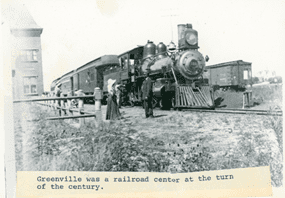
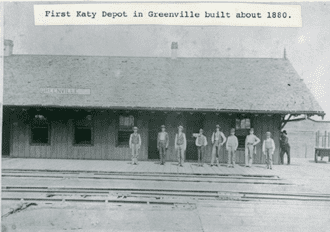
In 1888 Greenville granted approval for the City Railway Company to create a railcar for citizens. The first rails ran from Moulton Avenue south to Park Avenue. The railcars were not popular and stopped by 1891. The Greenville City Council gained approval via a vote by citizens to approve the Dayton Electric Company to construct a new rail line that was successful. Lines were expanded to Forest Park (Graham Park) into a destination stop with pavilions, and balloon ascensions. The line also provided service lines to Wesley College and Mineral Heights south.
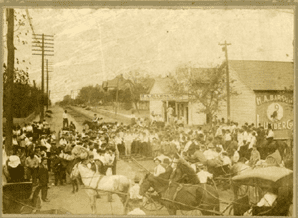
Although it took a while for the surrounding communities to get paved streets (Commerce, 1920; Celeste, 1935) the first paved transcontinental highway passed through Greenville. Started in 1916 and named Bankhead Highway after U.S. Senator John Bankhead, the highway extended from Washington, D.C. to San Diego by way of Alabama, home of Senator Bankhead. Its path crossed approximately 850 miles of Texas, from Texarkana to El Paso. It was designated State Highway 1 in 1917 by the Texas Highway Department. and roughly followed what became U.S. 67 and U.S. 80. It was an engineered roadway for local and regional traffic, as well as for military use. It also brought a new industry – highway tourism – to Texas. State Highway 1 would eventually become U.S. 67 that cut through downtown Greenville.[1]
The Jefferson Highway, established in 1915, was named for President Thomas Jefferson. It was a result of the early twentieth century’s Good Roads movement. Its route followed existing roads that extended from Winnipeg to New Orleans. In this way it passed through Minnesota, Iowa, Missouri, Arkansas, Kansas, Oklahoma, Texas, and Louisiana on different routes. It came through Greenville on what is now Hwy 69.
Interstate 30 construction began in 1955, with part of it first opening in 1957 between Dallas and Fort Worth. The construction of I-30 through Hunt County began in 1962.[2] I-30 is the shortest two-digit Interstate with a number ending in zero in the Interstate System. The Interstates ending in zero are generally the longest east–west Interstates. In Greenville, I-30 is also known as the Martin Luther King, Jr. Freeway. The effort to name this section of the highway after King first began with a resolution by City Council member Hattie Tennison, which passed in 1995. The name became official in 2010 with the unveiling of the new interstate signs. Interesting to note that both the Bankhead Hwy and Jefferson Hwy went through or next to downtown Greenville which before the installation of I-30 was a dynamic and thriving center for the community. That is where all the stores and restaurants were once located. Gradually, after I-30 was completed the box retail stores and restaurants all built along the new highway, pulling business away from downtown. In more recent years, efforts have and are continuing to be made to bring back the downtown area to once again become a center of activity.
[1] Albert F Mason, J.F.C. Moore, W. Walworth Harrison and Amanda Jayne Miller, Streetcars of the Texas Blacklands, (San Antonio: Texas Division, Electric Railroaders Association, 2017), 2-12.
[2] “Construction on Interstate 30 Due,” The Celeste Courier (Celeste, Tex.), Vol. 62, No. 47, Ed. 1 Friday, September 28, 1962, newspaper, September 28, 1962; Celeste, Texas. (https://texashistory.unt.edu/ark:/67531/metapth1223945/m1/1/: accessed August 11, 2022), University of North Texas Libraries, The Portal to Texas History, https://texashistory.unt.edu; crediting Leonard Public Library.
Recent Comments