
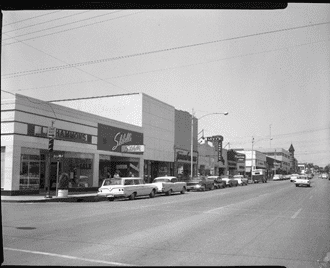
William Rosenthal came to the U.S. from Poland in 1873. He eventually made his way to Greenville, where he opened a furniture store in the early 1920’s. William Rosenberg, born in Germany, owned a wholesale liquor business in Greenville but left that line of business in the 1920’s due to Prohibition. Rosenberg then opened a seed shop. Archie and Sol Skibell moved to Greenville in the 1930s and eventually opened the very successful local clothing store La Mode.
Early settlers like Lowenstein and Popper helped to establish the Shaare Israel Congregation in 1899, but the congregation was mostly concerned with securing a Jewish Burial ground. Shaare Israel Cemetery, which is part of East Mount Cemetery, was purchased in 1899. Due to Greenville’s proximity to Dallas a synagogue was never built here. Many of the families living here already belonged to congregations in Dallas. Though services were held on the High Holidays in Greenville at William Rosenberg’s home and on numerous occasions at the Washington Hotel.
During the 1940’s there was an influx of Jewish families to Greenville. This growth allowed for the community to engage in more organized philanthropic groups. Women from several Jewish Families like the Glassman’s, Skibell’s, Swartz’s, and Tannenbaum’s formed the Jewish Women’s Club. The club was dedicated to social service work.
The Jewish and Christian populations of Greenville enjoyed a friendly and cooperative relationship. In 1919 the pastor of one of the local churches asked William Rosenberg to speak at the dedication ceremony celebrating the purchase of a new pipe organ. Sam Glassman also recalled an instance in the 1940’s when a local Baptist Church opened up their basement so that Jews could use the space to worship. In the 1950s the Jewish population in Greenville began to decline. Better economic opportunities in Dallas and Lubbock caused the Skibell and Stern families to move away. Many of the younger Jewish residents left Greenville in the pursuit of professional jobs elsewhere. Despite this, the Jewish presence in Greenville continued to influence the local economy and community life. Charles Glassman received the Worthy Citizen Award in 1952, and served as the president of the Greenville Chamber of Commerce from 1951 to 1953. Glassman was instrumental in convincing the aircraft manufacturing company TEMCO to set up its operation at Majors Field. TEMCO’s presence in the community revitalized the local economy and provided many jobs to Greenville residents. Levy’s Jewelry Store, which had been started by Ruth and Harry Levy, was sold to Al Lowenstein in the early 1950’s. Lowenstein ran the business until it closed in 2005, making it the last Jewish-owned business in Greenville at that time. Mollie Stigger was hired in 1972 as Levy’s first Black sales associate. She worked there until it closed.
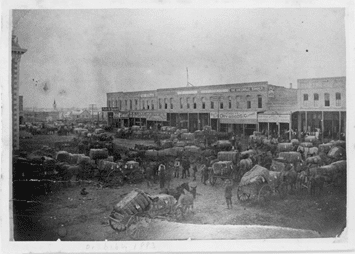
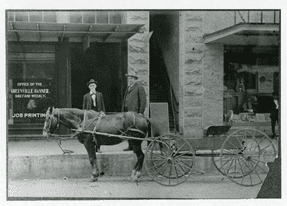
The Greenville Herald, believed to be one of Hunt County’s oldest businesses, was started in 1869 by John C. Bayne. The paper changed owners and introduced a daily newspaper called the Morning Herald before selling to the Poole family in the early 1900s and ultimately merging with the city’s other paper. The Independent began in 1875 also by Bayne. It was bought in 1882 and became the Independent Banner. It was a weekly paper at first but became a daily, the Evening Banner. The Banner was a hefty competitor of the Heralds for many decades and changed ownership a few times before the merger. They merged once they were both sold to Harte-Hanks Communications in 1956 and became the Greenville Herald Banner.
A family owned and operated business for over 65 years, Henson-Kickernick employed about 230 workers locally and about 600 nationwide. While headquartered in Greenville, HK was one of the most cutting-edge lingerie manufacturers in the nation, being the first to introduce a nylon line and the first to introduce Lycra panties.
Henson’s began in 1924 when John Henson bought Dixie Manufacturing, a men’s handkerchief business. In 1939, the Henson’s bought a rayon underwear factory and combined the companies. During WWII, the Henson’s plant manufactured handkerchiefs for the Army and slips and panties for the WAVES.
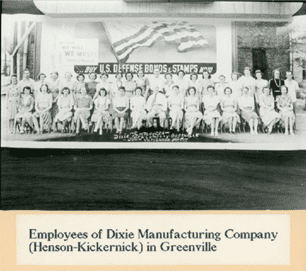
Although it made only inexpensive garments at first, the company, which changed its name to John W. Henson & Sons in 1946, began making the exquisite and high-quality women’s lingerie that made them world famous. In 1948 they expanded their line with fashion sleepwear.
In 1949 in Manhattan, Henson & Sons hosted press and buyers to a typical ranch breakfast at the Waldorf-Astoria. The big news was nylon, and this was the first nylon lingerie fashion show ever held. Word spread fast, and Henson’s quickly became nationally known.
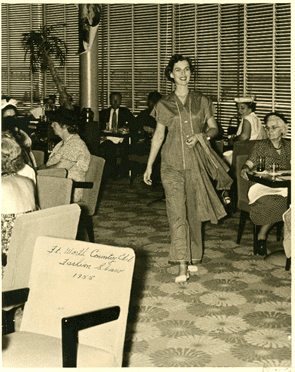
In 1958, Henson’s purchased Kickernick; which made HK one of the largest manufacturers of branded lingerie in the nation. Nell Winget began Kickernick in central Ohio in 1908 by making attractive sunbonnets that could be laid flat. She patented her design, and her thriving business went from sunbonnets and bungalow aprons to women’s and children’s underwear. In 1920, she became famous for her Suedron rayon knit bloomer that gave more sitting room for the wearer and, for the first time, had elastic at the knee. Kickernick instituted many innovations such as the “teddy bear” and the “combinette”, a one-piece combination of camisole and bloomer usually worn under the corset. In 1925, the bloomers were modified and called “kickernicks.” These remained in the line many years after Kickernick was purchased by Henson’s.
Recent Comments