
In the late 1850s, “Big” Jim Brigham bought his and his family’s freedom from Robert Neyland, a planter who owned land in northeastern Hunt County. Brigham founded Neylandville, the first all-Black community in the county and the only known all-Black incorporated municipality in Texas. After the Civil War, other formerly enslaved people moved to Neylandville, and by the 1900s, residents had formed a farmers co-op, which built a general store and a cotton gin and purchased a wheat drill and a wheat-harvesting machine.
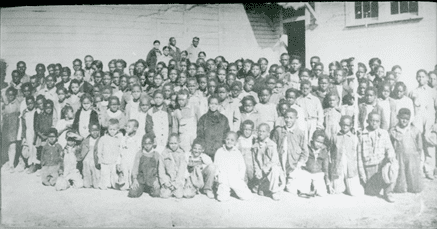
In 1888, Neylandville opened their first school, St. Paul’s, which began at St. Paul Baptist Church. It evolved into what was considered the best public Black school in a three county area (this was a time of state enforced racial segregation.) After the original school building burned in 1918, St. Paul School got aid from the Rosenwald Fund to build a new school.
St. Paul had a student population of 300-350, of which about 250-280 came from all over the county. It offered classes from first grade through twelfth. Prior to 1940, it was one of only a few Black schools in the area to offer vocational courses. In fact, three years of vocational agriculture for the boys and three years of homemaking studies for the girls was required for graduation. In 1938, a bus service was initiated to transport students from surrounding areas. Many years later, St. Paul School merged with Commerce ISD.
In 1917, Julius Rosenwald, president of Sears, Roebuck and Co. of Chicago, established the Julius Rosenwald Fund to help construct modern schools for Black children in the southern United States at a time when public schools in Texas were segregated by law. Between 1920 and 1932, the program donated over $28 million in fifteen states, and resulted in 527 funded buildings on about 466 school campuses in Texas alone.
Where the schools were built, Black communities had to contribute cash and in-kind donations of material and labor to match the grant. The school district was also required to take ownership of the property and maintain it as part of the public school system.
In 1922 – 1923, the Blanton School on Witt Street in Wolfe City was built, following the standardized plans provided by the Rosenwald Fund. It served first through eighth grades; graduates of Blanton School had no further educational opportunities beyond eighth grade in Wolfe City. Many students continued to work on farms or attended high school or vocational school elsewhere, such as St. Paul’s in Neylandville.
Black schools in Greenville began shortly after the Civil War ended and slaves were declared free. A White Northerner, Pitt Waggoner, established a school on the north side of town, near Clark Street that serviced both adults and children. In 1881, John Guest was hired to teach the Black free school in Greenville for $20.00 a month. In the late 1880s, Will Ross, a graduate of Fisk University, became their first prepared teacher. Several years later, the first Black Greenville pupil of the school to have graduated from college, T. W. Pratt, came back to teach. He organized the first Black high school and named it Ross High School, after his teacher who had inspired him to continue his education.
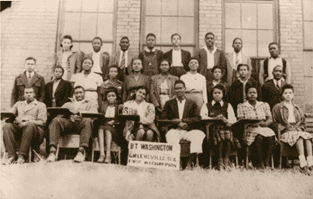
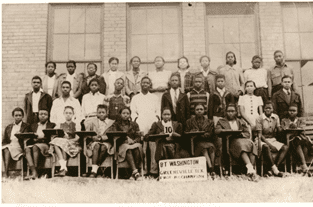
Several years later the name of the school was changed to Booker T. Washington High School. It educated Black children from grades 1 – 12. For many years, there was only one Black school in Greenville. In 1900, after a number of citizens on the east side of town bought a lot, the school board bought an old building and placed it on the 1300 block of East Marshall Street. The Frederick Douglass School and the Savannah Schools opened in the early 1900s and served grades one through eight.
In 1950, Carver High School was built on West Lee Street for grades 7 – 12; the other two schools served elementary students. When Greenville integrated in 1965, the three black schools became integrated elementary schools.
The Farmers’ Improvement School, commonly known as F. I. S. College, flourished for almost forty years outside of Wolfe City in the early part of the twentieth century. Not really a college in the modern sense of the word, F. I. S. was an affiliated high school and trade institute for young Blacks interested in agriculture. The school began with only a few thousand dollars of donations and twenty-five acres of land located three miles southwest of Ladonia near the Hunt County line just south of the Santa Fe Railroad. The first permanent building was erected in 1908 at a cost of $3800.00 which was funded by Robert Lloyd Smith and Ruby Cobb Smith. Mr. Smith was a follower of Booker T. Washington who founded several cooperative ventures including the Farmers’ Improvement Society of Texas and a farmers’ bank in Waco. From this modest start the physical plant of the school grew to four large buildings which housed the various activities of the school, as well as dormitories for the students and faculty residences.
F.I. S. was a boarding school, with twelve grades from elementary through high school. For 1911, the tuition was $7.00 per month which included room and board. In addition, students worked part time at the school to support themselves. Enrollment averaged about 90 students per term.
The institution operated on the principle that young people learn by doing. Both students and faculty divided their time between farm chores and academic instruction. Money to support the school program came from income produced from the 90-acre farm, student tuition and donations. The state of Texas did not financially support the school.
During the 1930s, F.I.S. gradually declined in popularity. It closed its doors at the end of the 1946-47 academic year, a casualty of the rapid decline of small farms and the emergence of public high schools for Blacks.
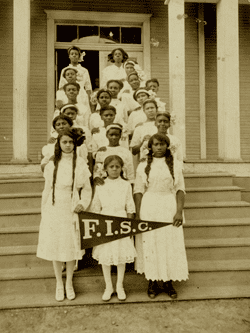
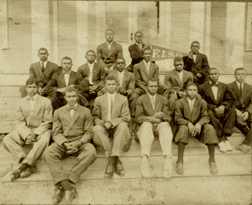
The first school for Black children in Commerce was established in 1897 in the Boatley Street Masonic Hall. It had one teacher, William T. White, who taught all of the classes for grades 1-7.[1] In 1910 the school moved into the Griffith Chapel Methodist Church (at the corner of Railroad and Givens Street).[2] In 1914 land was donated by P.A. Norris to build the Norris School which was a one room structure. From about then to at least the 1940s the Norris School taught up to 9th grade and if students wanted to continue past that they had to enroll either at F.I.S. College (a private Black school between Wolfe City and Ladonia) or Center Point (a private Black college near Pittsburg).[3] By 1949 they taught through 10th grade and after that students went to the St. Paul School in Neylandville at their own expense until the school was able to purchase a bus that transported the students. [4] In 1953 they built a new school building and in 1954 they became a four year high school with 44 students enrolled.[5] In 1960 the St. Paul school closed and Neylandville students had the choice to go to Greenville or Commerce. This brought at least 45 new students to Norris. In 1965 at integration the Norris School became the location for the integrated sixth grade class of Commerce.[6]
[1] Handbook of Commerce Texas 1872-1985, 48-49.
[2] Handbook of Commerce Texas 1872-1985, 48-49.
[3] Handbook of Commerce Texas 1872-1985, 48-49.
[4] Handbook of Commerce Texas 1872-1985, 48-49.
[5] Handbook of Commerce Texas 1872-1985, 48-49.
[6] Handbook of Commerce Texas 1872-1985, 48-49.
Recent Comments