
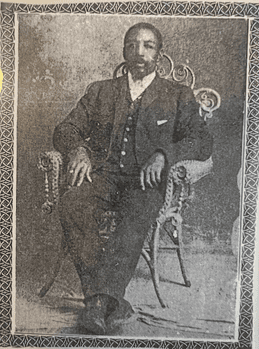
A.J. Hurdle
Trig Ward’s grandfather was the founder of Center Point Christian Church and Clark Street Church. He passed away in 1935.
Andrew Jackson Hurdle was born into slavery in North Carolina on December 25, 1847. He was a Reverend, President of the Northeast Texas Christian Missionary Convention, and founder of the Northeast Texas Christian Theological and Industrial College. In 1858 he was sold off from his family and sent to Daingerfield, Texas, to work on the plantation of T. H. Turner. During the Civil War he managed to escape. While eluding his pursuers, he came upon a detachment of Union soldiers. Hurdle served as the unit’s horse groom and remained with them until the conclusion of the war.
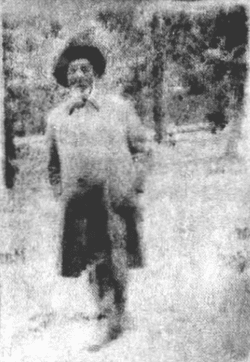
After the war, Hurdle settled outside of Greenville, Texas, near the freedmen’s community of Center Point. A self-educated man, he worked at various times as a horse trader, cobbler, bottler, and as the manager of a sorghum syrup mill, and eventually he came to own 500 acres. In 1868 Hurdle married Viney James Sanders, the biracial daughter of a White man, and together they had seventeen children—nine boys and eight girls.
A devout Christian and leading member of the Christian Church (Disciples of Christ), Hurdle was ordained as a deacon in 1874 and became a minister in 1880. He went on to help organize the Clark Street Christian Church in Greenville as well as the Center Point Christian Church, where he pastored for many years. The Clark Street Christian Church was organized in August 1865. C.C. Haley, A.J. Hurdle and E. Clark had been ordained in the ministry in the Christian Church. Both groups worked together and soon had buildings built and A.J. Hurdle became the pastor of Center Point while C.C. Haley became pastor of Clark St.
When it was first organized the members of the Wesley Chapel Colored Methodist Episcopal Church and the Christian Church worshiped in the same building. Eventually, the Methodist members purchased a site on east Henry Street while the Christian Church members had one acre about ½ mile from the courthouse that was then known as “Across the Thicket.” Sometime later it became called by its current name – Clark Street Christian Church. Their first service was actually held in a one-room schoolhouse. L. H. Crawford built the first brick Christian Church on Clark Street in 1916. This building was demolished in 1970 and a new one was built. The church’s “Feed the Hungry” program was originated in 1989 by Sister Earnestine Williams who wanted to provide meals to anyone who desired them on Thanksgiving and Christmas Day. This program continues to this day. The church made history in December of 1993 by calling Rev. Jeanette Jackson as its pastor. They believe she was the first female pastor of an African American Disciples of Christ Church and served the church until August 1994.
He also led congregations in Caddo Mills, Rockwall, Cedar Grove, Mount Vernon, Campbell, and Terrell, Texas. In 1900 he helped found the Northeast Texas Christian Missionary Convention of the Christian Church (Disciples of Christ) in Daingerfield, Texas, and in 1901 he was elected president of that organization; he held that position for twelve years. As head of the convention, he organized the Northeast Texas Christian Theological and Industrial College, an all-Black college near Palestine. The school opened in January 1912 and was led first by D. T. Cleaver and then by Hurdle’s son, Isaiah Q. Hurdle. However, in 1920 the school mysteriously burned down and was never rebuilt.
Following the death of his first wife in 1904, Hurdle married twice. In 1906 he married a woman who abandoned him shortly thereafter and died in 1912. In 1915 Hurdle, well into his sixties, married twenty-five-year-old Jessie Catherine Bailey, a school teacher from Big Sandy, Texas. She bore him eight more children before his death in 1935. This made Hurdle the father of twenty-five children in total.
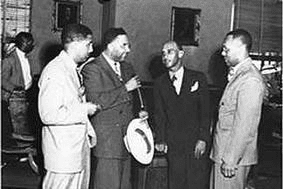
William Joseph Durham
William Joseph Durham was born on a farm near Sulphur Springs on April 6, 1896 and died Dec. 22, 1970 in Dallas. He is buried at East Mount Cemetery in Greenville. After completing one semester at Emporia State College in Kansas, he served in the United States Army in France during World War I. After the war, he studied law in the office of Ben F. Gafford, a White attorney in Sherman, Texas. Durham passed the bar examination in 1926 and established his practice in Sherman, where he took on civil-rights cases, even though in the Sherman riot of 1930 a lynch mob burned the Black business district, including Durham’s office. Though such lawsuits were rarely profitable, Durham had a lucrative practice as legal counsel to an insurance company and could therefore spend part of his time fighting for equal rights.
By 1940 he was recognized as the leading Black lawyer in Texas. Gasoline shortages during World War II and his growing business ties and activities in the National Association for the Advancement of Colored People in Dallas gave Durham enough reason to move in 1943 from Sherman to Dallas, where he became known not only as a civil-rights champion and the most effective Black leader of the NAACP, but for his effectiveness in court and pretrial strategy. He took part in more than forty civil-rights cases involving such causes as school integration, voting rights, and equalization of teachers’ salaries. He and other attorneys fought successfully to enroll Herman M. Sweatt at the University of Texas law school, to which Durham advised Sweatt to seek admission. Durham knew that there was no law school for African Americans in the state at that time and that UT would consequently be particularly vulnerable to a lawsuit if the school rejected Sweatt on the basis of race. Durham became best known for the school-integration cases in which he and his associates went to court to implement the 1954 Supreme Court Brown v. Board of Education rulings. Additionally, Durham was on the national board of the NAACP and assisted in directing its education and legal-defense fund. He also helped organize the Texas Council of Voters.
Recent Comments