
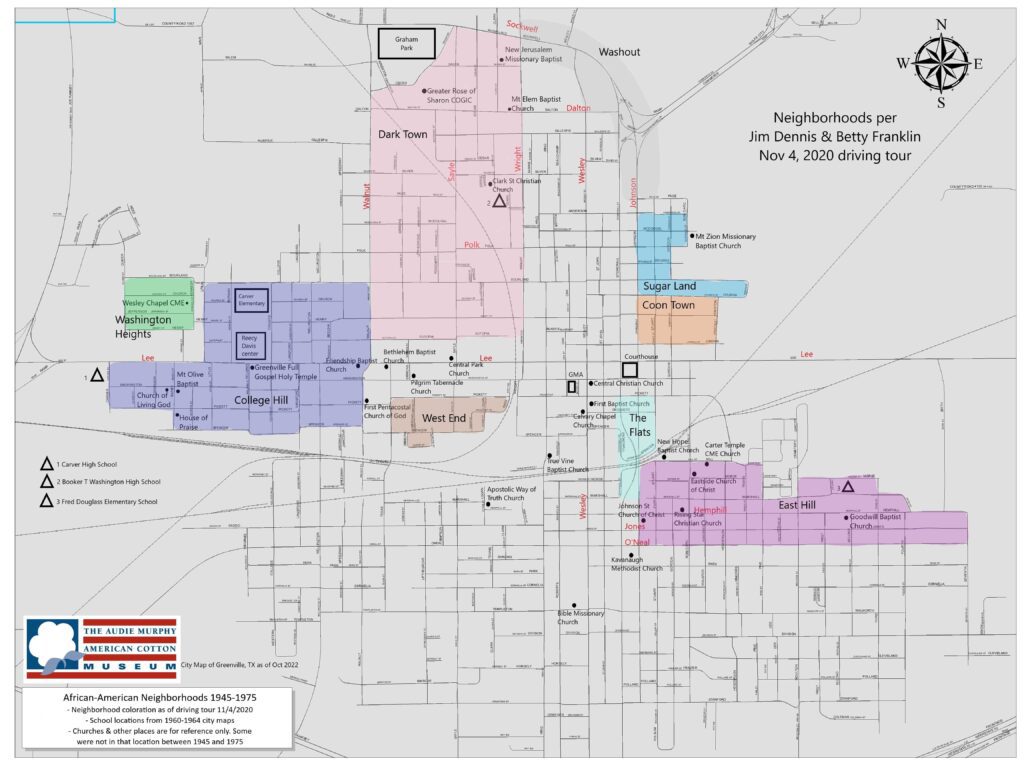
Segregation laws denied Blacks access to opportunities of life to Whites. Despite that, the Black community in Greenville grew and thrived throughout the 1900s. As Black people moved into the city, the majority were required, and in some cases had no other options, but to live in what were often the poorer parts of town. Their strong connections with family, friends and neighbors resulted in many vibrant, active neighborhoods that are still well-known today.
College Hill
Burleson College, Carver and Savannah schools were located here.
Coal Shoot
Near Katy Railroad station. Also called ice alley because of ice plant located nearby.
West End
Primarily houses with a mix of White and Black people.
Snuff Dipping Alley
Small area in middle of west end. Got its name because most of the older women who lived in this area dipped snuff. Nick’s Grocer was also located here.
Wood Lot
Was a row of about ten houses fenced in. It got its name because one of the men cut and sold wood.
Dark Town
Derived its name because it had no streetlights. The first schools for Black children located in this area – Ross & Booker T. Washington. This area received the first community development block grant to pave its streets.
Sugar Land
This flood-prone, kinfolk area was named after the sugar cane grown nearby and had two neighborhood grocery stores and a beautician.
Coon Town
While the name for this community uses a derogatory word, it was named by the community itself in a silent protest similar to how Blacks expressed themselves through songs, words and dancing when they were slaves. The 1908 burning of 18-year-old Ted Smith took place in the market square. This neighborhood is one block North of the market square.
Flats
Often considered the Black business district and a safe space for Blacks to congregate and socialize. One of the only two Black movie theaters (Pastime Motion Picture) in Greenville was located here. There were 4 well-known restaurants – McDaniel’s, Buck Truss Restaurant, Glass Front Café and Dewey Fitzpatrick’s Spare Rib BBQ Restaurant. The only hospital and clinic available for Blacks was also located here. The flats also had music, dancing, partying and gambling.
East Hill
The second Black school was located here – Fred Douglas Elementary School. The nearby East Mount Cemetery was originally a segregated burial place. A Cotton gin and slaughter pen was also located here.[1]
[1] Community descriptions came from The Blackest Land, The Whitest People by Brenda Huey.
Recent Comments