

Harold Payne
Harold Payne was born in Caddo Mills on Feb. 12, 1921, and died Dec. 8, 2013. He attended East Texas State University and enlisted in the Army Air Corps late in 1942. He “had already had his mind made up for the B-17.” Payne and “Payne’s Punch Packers,” as his crew was known, were part of the 8th Air Force, 390th Bomb Group, 570th Squadron. They carried out missions over Czechoslovakia and France from 1944-1945. He flew over 25 missions. After the war, Payne started Payne’s Famous Furniture Village in Caddo Mills in addition to becoming a land developer. He and his wife Wanda were married nearly 65 years when she died of cancer. Payne was also a founding member of the 390th Bomb Group Memorial Museum in Tucson, the 390th is one of the few groups that has its own museum.
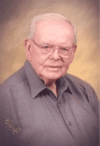
D. A. Steele
David Addison “D.A.” Steele, Jr. was born in Greenville on Oct. 20, 1919, and died Aug. 13, 2011. He attended a couple of years of college at East Texas State University. After he earned his private pilot’s license, Steele entered the Army Air Corps in November 1941. He completed primary training at Victorville Air Force Base in California, where he was commissioned as an A-rated pilot and 2nd Lieutenant. He was a B-17 pilot with the 306th Bomb Group (Heavy), 423rd Squadron. Although he flew other planes, Steele “liked the way the B-17 flew.” Steele received the Distinguished Flying Cross, the Air Medal, and 3 Oak Leaf Clusters while overseas. After flying the required 25 missions, Steele was able to come home in 1942 after which he married his pre-war sweetheart Bea Groover and started raising a family. A life-long lover of wood-working, Steele owned Cabinet Works located behind the Farmer’s Market. He was a member of Central Christian Church since 1929, where he served as a deacon and trustee emeritus.
Harold Payne and D. A. Steele, who were friends since they were in college prior to the war, were the only known B-17 pilots in Hunt County. A crew had to fly 25 missions before they could go home; however, the odds of surviving to the 25th mission were only one in three and both survived to make it home.
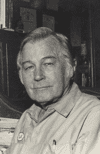
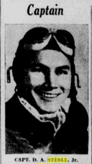
Robert Neyland
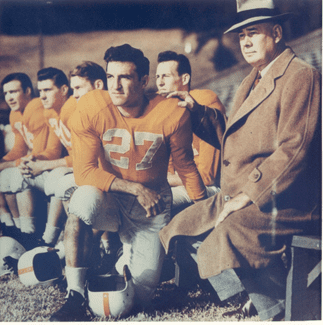
Robert Neyland was born in Greenville on Feb. 17, 1892, and died in New Orleans on March 28, 1962. Neyland was a champion athlete at West Point and Army officer in two world wars who served three stints as the head football coach at the University of Tennessee (1926-1934, 1936-1940, 1946-1952). He remains the all-time winningest coach in Volunteer history with 173 wins in 216 games, 6 undefeated seasons, 7 conference champion-ships, and 4 national championships.
A superb student and athlete at West Point (1912-1916), Neyland was dubbed the “greatest all-round athlete” in the history of the Point; he won 20 consecutive games pitching for Army, was a starting end on the Cadets’ 1914 national champion football team, and was the USMA’s heavyweight boxing champion his final three years. After graduation, he earned a degree in engineering from M.I.T.
As a career army officer, Neyland served with distinction in France during WWI, on the Mexico-Texas border against Pancho Villa, and in Asia during WWII in the China-Burma-India Theater. Decorated by the U.S., British and Chinese governments, Neyland retired from the Army as a brigadier-general in 1946.
But it was as head coach of the Tennessee Volunteers that Neyland achieved fame. His tenure at U.T., twice interrupted by military tours of duty, spanned 21 seasons. In his first four years as head coach, the Vols lost only one game. His won-lost percentage of 82.9 is the best of any man who coached 20 years or more. His 1938-39-40 teams recorded an amazing 17 consecutive regular season shutouts.
Neyland was also an innovator. He is credited with being the first football coach to utilize sideline telephones and game films, to cover the playing field with a tarp, and to put tearaway jerseys on his backs and ends to help them break tackles. Shortly before his death, Neyland drew up plans for a major expansion and renovation to the Vols’ home stadium which was renamed in his honor before the 1962 season. The plans he drew up were so far ahead of their time that they have been used as the basis for every major expansion since then. After stepping down as head coach after the 1952 season, Neyland remained as athletic director at UT until his death in 1962.
Neyland is also famous for creating the seven “Game Maxims” of football that many coaches, on all levels, still use. To this day, Vol teams still recite them in the locker room before every game.
Seven Maxims of Football
- The team that makes the fewest mistakes will win.
- Play for and make the breaks and when one comes your way–SCORE.
- If at first the game–or the breaks–go against you, don’t let up. . . put on more steam.
- Protect our kickers, our QB, our lead and our ball game.
- Ball, oskie, cover, block, cut and slice, pursue and gang tackle. . . for this is the WINNING EDGE.
- Press the kicking game. Here is where the breaks are made.
- Carry the fight to our opponent and keep it there for 60 minutes.
Recent Comments