

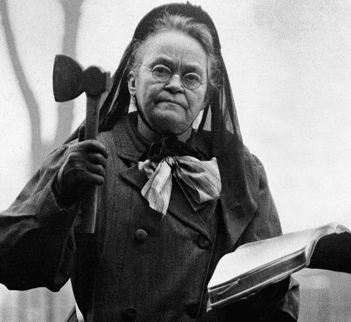
In the nineteenth century, alcohol consumption in Hunt County was part of normal life. Many of the towns had drinking establishments. This practice came into question with the rise of the movement to ban the consumption of alcohol (the Temperance Movement). This, coupled with the growing popularity of Progressive ideals, began to change opinions. A number of local people, including women and pastors, began pressing for prohibiting the consumption of alcohol. Carrie Nation, a famous Temperance Movement leader, came to East Texas Normal College in Commerce, Texas, on March 30, 1905. She did not brandish her notorious saloon-smashing hatchet and the Commerce Journal reported that she appeared to be a “calm, logical, yet, eloquent speaker.”[1] Nation also addressed the physical, and mental effects of tobacco, especially cigarettes. Nation then called for “girls to refuse the compliments of boys that use tobacco.” Saloons in the region began to close after the prohibitionists were successful on the July 18, 1903, local election in Hunt County.[2]
[1] W.A. Foote, “Mrs. Carrie Nation’s Lecture.,” Commerce Journal (Commerce, Texas, March 31, 1905), Vol. XV, No. 33. edition, accessed June 18, 2022, http://commerce.advantage-preservation.com.
[2] Conrad, Blacklands, pages 76-78. Harrison 206. The dates and history on when Hunt County became dry is a difficult one to pinpoint, since seems to be a local issue before the 18th Amendment.
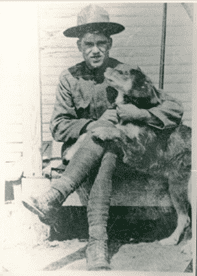
When the First World War began in Europe in August of 1914, Americans were neutral. The Government stressed the importance of neutrality since German ethnic ties were strong in the states. President Woodrow Wilson won reelection in 1916 on the slogan, “He kept us out of War.” Yet, by April 1917, the United States was at war with Imperial Germany. Public opinion changed in local newspapers from neutrality to patriotism overnight in early 1917 with Imperial Germany announced unrestricted submarine warfare, and the Zimmerman Telegram offered former U.S. lands to Mexico if they declared war on the United States.
Following the upsurge in national feeling, Commerce bought a new flag that was 15×25 feet for a seventy foot flag pole at fifty dollars for the Hunt County Courthouse.[1]
Young men were encouraged to enlist and later required to register for the draft under the Selective Service Act. Some joined Home Guards that were incorporated into the National Guard. Women in Commerce and Greenville both established their own Red Cross Auxiliary chapters. Local businesses provided workspaces, tables, sewing machines, pins and needles to the local chapters so they could create hospital goods.[2] By the end of 1917, Hunt County contributed $350,000 of the $5,000,000,000 raised nationally through the Liberty Bond drives.[3] Guest speakers, including Congressman Sam Rayburn, visited Greenville to encourage people to buy Liberty Bonds.[4]
[1] Hart Sterling, “Has Ordered Flag For Court House,” The Commerce Journal (Commerce, Texas, April 6, 1917), Vol. XXVIII, No. 14. edition, sec. I, accessed June 28, 2022, https://commerce.advantage-preservation.com. I believe there is a photograph of the flag unveiled on April 21, 1917 in Carol Taylor’s picture book.
[2] Sterling Hart, “Girls Encouraging Men to Enlist,” The Commerce Journal (Commerce, Texas, April 27, 1917), Vol. 28, No. 17, Ed. 1 edition, accessed August 11, 2022, https://texashistory.unt.edu/ark:/67531/metapth1359422/.
, Hart Sterling Jr, “Congressman Sam Rayburn to at Greenville.,” The Commerce Journal (Commerce, October 19, 1917), Final edition, sec. 1, accessed June 29, 2022, https://files.zotero.net/eyJleHBpcmVzIjoxNjYwMjU4NTE1LCJoYXNoIjoiMTkwNGVjZWJhNDg2Yzc3NjIwYWI4MzE1NTkwYzczNGQiLCJjb250ZW50VHlwZSI6InRleHRcL2h0bWwiLCJjaGFyc2V0IjoidXRmLTgiLCJmaWxlbmFtZSI6Imh0dHBzOlwvXC9jb21tZXJjZS5hZHZhbnRhZ2UtcHJlc2VydmF0aW9uLmNvbS5odG1sIn0%3D/41adce1640844326cbe821f5cab899a8943e08cce4d641b911502fab08ec4ba4/https%3A%2F%2Fcommerce.advantage-preservation.com.html.
[3] November 2, 1917
[4] Hart Sterling Jr, “Congressman Sam Rayburn to at Greenville.,” The Commerce Journal (Commerce, October 19, 1917), Final edition, sec. 1, accessed June 29, 2022, https://files.zotero.net/eyJleHBpcmVzIjoxNjYwMjU4NTE1LCJoYXNoIjoiMTkwNGVjZWJhNDg2Yzc3NjIwYWI4MzE1NTkwYzczNGQiLCJjb250ZW50VHlwZSI6InRleHRcL2h0bWwiLCJjaGFyc2V0IjoidXRmLTgiLCJmaWxlbmFtZSI6Imh0dHBzOlwvXC9jb21tZXJjZS5hZHZhbnRhZ2UtcHJlc2VydmF0aW9uLmNvbS5odG1sIn0%3D/41adce1640844326cbe821f5cab899a8943e08cce4d641b911502fab08ec4ba4/https%3A%2F%2Fcommerce.advantage-preservation.com.html.
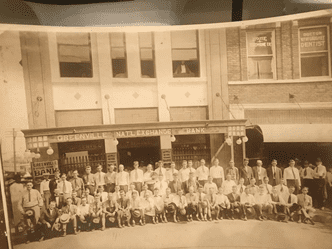
By October 1918, the influenza pandemic reached Hunt County. Local newspapers began running national and local articles briefing the public on who had contracted influenza and had died.[1] Local businesses began to temporarily shut down and evening prayer meetings were cancelled.[2] On October 15, 1918, the city closed all public gatherings to try to prevent the spread of the disease. The Greenville Evening Banner posted a full page entitled ‘Keep Well: How To Avoid Influenza And Other Sicknesses.’ It described how to prevent the spread of influenza at work, home, and even how to take care of the sick by wearing a mask. There was also a mention of “Rules for Everyone to Follow,” such as “Protect others by sneezing and cough into handkerchiefs or cloths which should be boiled or burned.” Everyone “shall wear a gauze mask which should cover the nose and mouth and be tied behind the mask.”[3] It’s estimated that 675,000 Americans were killed from the virus; numbers for Hunt County are inconclusive.
In 1919, the 18th Amendment, which established the prohibition of alcohol in the United States, was ratified. Under state local option laws, Hunt County towns previously voted to become dry in 1911. Around the time of WWI there was also a resurgence of the Ku Klux Klan. At its height in the early 1920s the new Klan boasted some two million members. Membership in the state of Texas numbered in the tens of thousands. While the revived Klan often portrayed itself as a fraternal lodge which championed traditional morality and prohibition, they used their political power to enforce white supremacy and their vision of social order. The greatest number of members were concentrated in small towns but the organization also spread to Dallas, Houston, San Antonio and other large cities. On December 16, 1921, approximately 600 Klan members marched in downtown Greenville in front of thousands of spectators. Members came from all sectors of society, including some civic leaders, politicians and law-enforcement officials. There were also many officials who opposed the Klan as well. One example was when Waco Klan No. 33 tried to march in Lorena, the sheriff of McLennan County tried to stop the demonstration, touching off a riot in which several people were wounded and one killed. The growing violence attributed to the Klan caused wide resentment and by 1922 a number of anti-Klan organizations began to be formed across the state. Dissension within the organization and growing anti-Klan sentiment combined to weaken its influence. By 1928 the membership had declined to around 2,500 in Texas and many prominent supporters had left the organization.
[1] “Greenville Evening Banner. (Greenville, Tex.), Vol. 25, No. 165, Ed. 1, Monday, October 14, 1918,” Newspaper, The Portal to Texas History, last modified October 14, 1918, accessed July 12, 2022, https://texashistory.unt.edu/ark:/67531/metapth121651/m1/8/zoom/.
“Http://Commerce.Advantage-Preservation.Com,” accessed July 12, 2022, http://commerce.advantage-preservation.com.
“Greenville Evening Banner. (Greenville, Tex.), Vol. 25, No. 166, Ed. 1, Tuesday, October 15, 1918,” Newspaper, The Portal to Texas History, last modified October 15, 1918, accessed July 12, 2022, https://texashistory.unt.edu/ark:/67531/metapth121652/m1/3/zoom/.
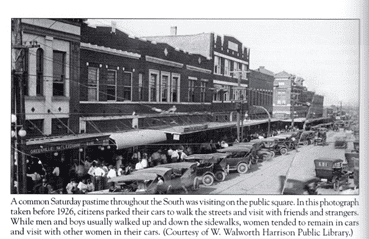
By the 1920s Hunt County population was 50,350. Known as the “Roaring Twenties” it was a prosperous decade for some, but not for all. By the end of the decade the national stock market would crash, resulting in the 1930’s economic disaster known as the “Great Depression.”
Hunt County’s first radio station was KFPM, operated by David Ablowich, Jr., located at the New Furniture Company downtown Greenville in 1924.[1] The radio station published schedules in the Commerce Journal. KFPM broadcasted church services, thirty minutes of records of music from Victor and Columbia Records, daily baseball reports, and hosted performances from local glee clubs.
The 1920s also saw the arrival of the Big Rat Hunt in the county. In 1927, Texas launched a statewide effort to get of rats that were running rampant. Hunt County joined the effort with other counties in December on a four-week campaign to kill rats. Awards were offered to those who were killing the most rats. The state government, believing children would be more enthusiastic rat killers than adults, announced a program to pay schoolchildren a penny a tail in this public health endeavor. To prove that the rat had actually been killed, the students had to bring the tail in to school in order to receive their penny. In each school, a teacher was appointed as a rat tail counter which invariably ended up being the newest teacher on the job.
Sterling, Hart. The Commerce Journal. (Commerce, Tex.), Vol. 35, No. 16, Ed. 1 Friday, April 18, 1924, newspaper, April 18, 1924; Commerce, Texas. (https://texashistory.unt.edu/ark:/67531/metapth1359603/m1/1/: accessed July 5,, 2022), University of North Texas Libraries, The Portal to Texas History, https://texashistory.unt.edu; .
Recent Comments